


 Canada
 Other countries
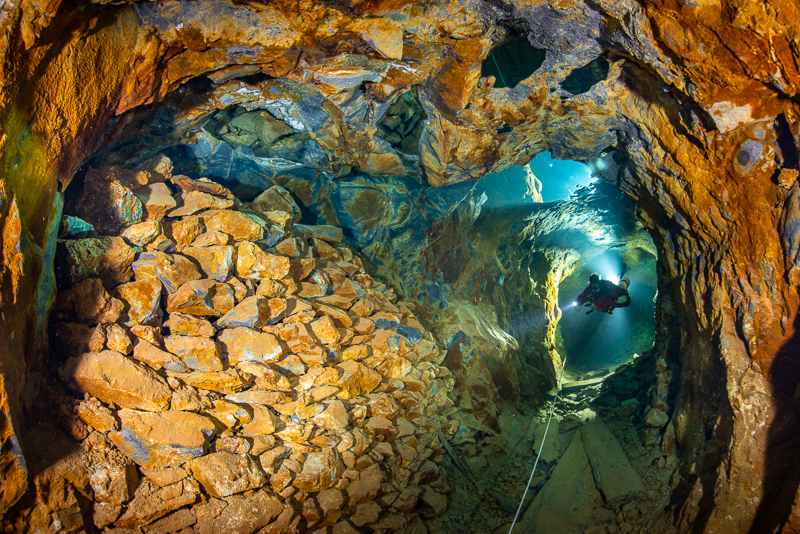

World of colours
Trees team in autumn colors. Jozef, the portal to the mine, lies on a small meadow beneath a ripe deciduous forest. Kilometres of excavated tunnels lead from the dark to the surface and end with a number of entrances and downcasts. Some are known and visited occasionally, while the others are forgotten and in the surrounding forest they peacefully exhaust the cold smell of the past. Nowadays Jozef is the only one that is used as an entry to the underground. Through massive wooden door that guards the entrance chilly breeze rushes out.
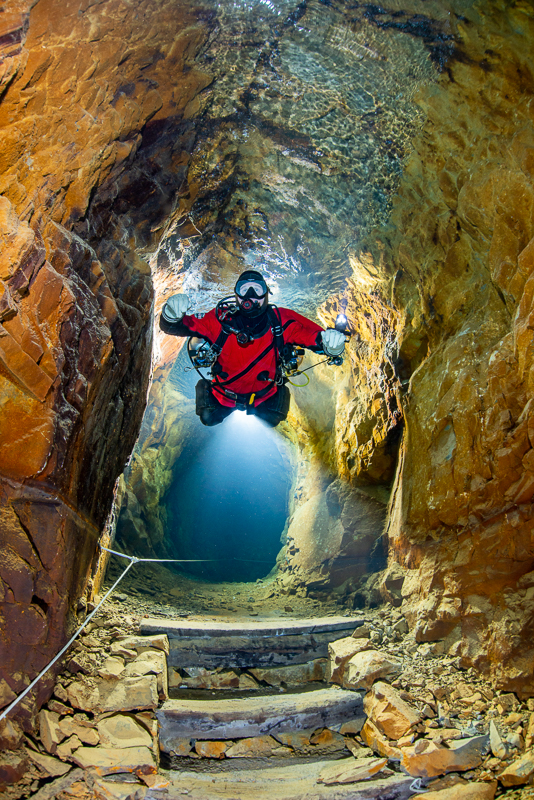
When I enter the underground, the atmosphere changes dramatically. Behind thick door, pleasant warm breeze with the smell of fallen leaves is replaced by heavy humid 5°C air. With first heavy load on my back I walk through serious of horizontal tunnels and pass several crossroads. The hundred years old nicks of mattock are still visible on painted walls. Thoughts of getting lost in the emmental-like web of tunnels don’t allow me to check the paintings closely. In order to find the way back, I try to memorise surrounding marks and shapes. As the walls look different the other direction, I often stop, turn around and try to capture the view backwards even more precisely. Yet, it doesn’t work and I have to rely on Peter’s orientation. Without him the way back would be lost. Finally, muddy stairs bring me down to the lowest dry level. Entrance to crystal clear water is now just around corner, the portal Jozef though good 300 meters far away.
The precious opal was discovered in the middle Ages and its name comes from the ancient Indian word “Upala” – ‘precious stone’. Pliny the Elder, a Roman author, wrote: “Made up of the glories of the most precious gems, to describe them is a matter of inexpressible difficulty. For there is amongst them the gentler fire of the ruby, there is the rich purple of the amethyst, there is the sea-green of the emerald, and all shining together in an indescribable union. But where does all these colours come from? Several millions of years ago, the hill was a volcano. When it erupted, lava rich on minerals formed the upper layer of ore. The minerals dispersed in water traveled through cracks and left colourful footprints inside the ore. Wherever the paint hit the silica deposit, it penetrates in and creates shiny colouring inside transparent material – Opal gem.
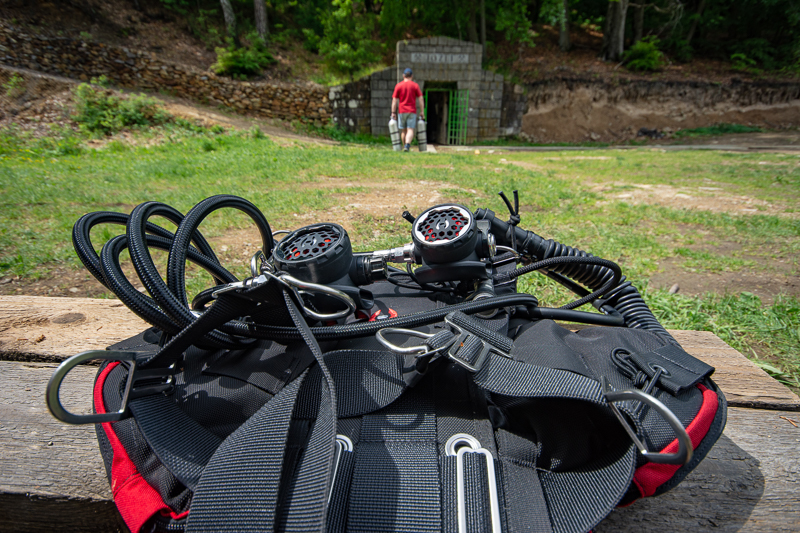
After three trips in and out carrying heavy gear, the rebreather, stages and camera kit is ready to dive. My body slowly cools down. In darkness nothing but my breath can be heard. The headlamp illuminates the steam coming out of my mouth. I feel exhausted. The Roman senator Nonius was so obsessed with the beauty of his opal ring that he chose living in exile rather than giving up his precious in favour of emperor Marc Anthony. I would rather choose a rest instead of diving, but there must something about this spot. I will not give up now.
Artist’s gallery
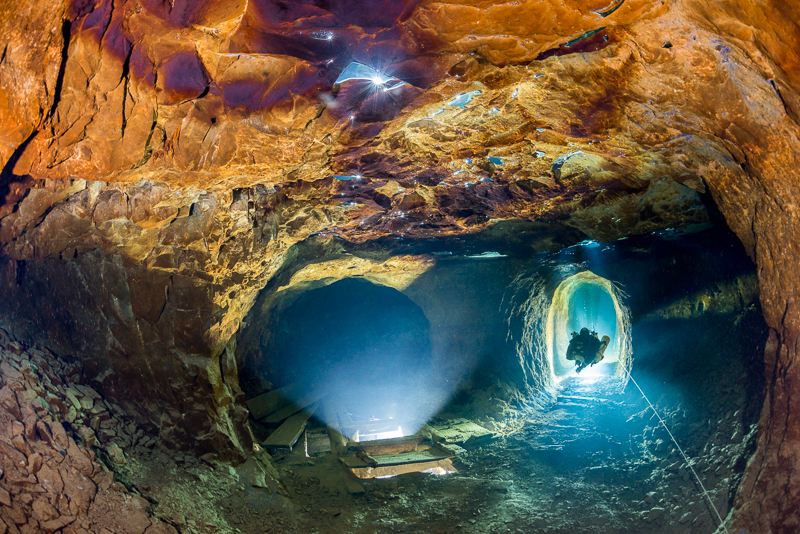
Kidded up in rebreathers, stages, carrying a camera rig and couple of external off-board strobes, with Peter we submerge though a 45 degree shaft. Due to our activity, the visibility around the entrance is almost zero. But once the view opens up, we enter the world of colours. Only now the real paintings are revealed. Unlike in dry parts, down here the walls are covered in a mineral shell. The same minerals that disperse in water and travel in tiny streams through cracks in ore, underwater they oxidise in slightly acidic water and form a “rusty” shield a top of shaped rocks.
This is a hidden underwater gallery, where the same paint is used featuring different artistic technique. Furthermore, the acidic water keeps the paintings free of dust, conserved in best conditions.
As I move through tunnels, the paintings on the walls change. I In a shallow corridor some 200 meters inside, the walls are covered in vibrant purple. Next chamber teams in orange. Going through chambers feels just like walking from one exhibition to another, from one melancholic mood to the next.
Slovak opals are highly prized at the world markets for their opalescence (perfect play of colours) but only now the connection between the source and result is clear. As the predominant color on the walls changes, it automatically connects my imagination with the matching color in the opal gem.
In some parts the exhaled gas remains trapped under the ceiling and forms gas capsules. Some of them are big enough to reflect the light from diver’s torch and turn into a glistening sheet on the floor and colourful walls. When more light sources are combined and the gas capsules move, it results in a lighting effect that emphasises the play of colours even stronger. I might be crazy, but all the colours and light shimmering reminds of nothing else but opal gems. Or maybe I got obsessed with that beauty, just like senator Nonius. Or maybe my brain stopped working properly due to cold breaking inside of my body.
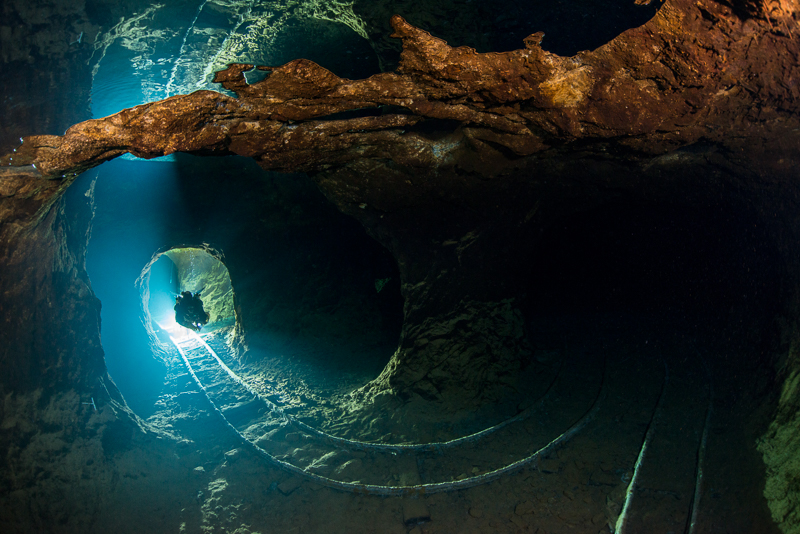
Descending down to deeper horizons, the amount of sediment on the floor rises and the mineral shield on the walls gets thicker. At the lowest levels of the mine, the best quality opals have been found. From here the world’s largest piece of precious opal was brought to the daylight some 240 years ago, weighing 3,035 carat (594 g). It makes me wonder if there are any opals left on the floor or trapped next to diver’s path, waiting to be revealed and taken. Maybe I should give it a try and dig right here or there. Maybe I get rich over night. Though the layer of super fine sediment stops every attempt of searching as it immediately restricts the view and causes potential danger for me and my dive buddy.
In the endless corridors, the traces of human mining work such as old ladders, mattocks, tracks, and constructions have been left. Here the time has stopped some hundreds of years ago. Considering that every piece, every part of equipment around, is more than 100 years old, ads a smell of the history to every breath. One can almost see the workers back in 1918 leaving the tools on the floor knowing that there is no working day tomorrow. The cold penetrates deep into my bones. I constantly need to move my fingers in order to keep them functional. Even pulling the trigger on my camera becomes difficult.
Land of wonders
Oxides of iron are predominantly present in this volcano hill. The gravity and contact with acidic water allows rusty stalactites to form, reaching several tens of centimetres in length. In some parts the decoration looks just as rich as the ones in limestone caves. But these limonite structures don rich orange color, are fragile and collapse easily just from touch of exhaled bubbles, hence an extra care is needed when moving around them. The deepest corridors remind of fairy tale. The richest concentration of minerals in ore covers the walls in super vibrant shades of purple and red. The floor and nook spaces collect a thick layer of rusty limonite dust. A layer of dust hangs just above the floor like a morning mist.
Hundreds of tons of volcanic material was brought up to the surface using railways but even more excavated material was stored in the “dead tunnels” and blocked off by creating artificial walls. Whereas the natural walls are stable, the artificial walls created with drained material mean potential threat. When these collapse and they occasionally do, the rocks obstruct the tunnel, smother the guiding line and leave the diver in zero visibility. But for now I enjoy the some of the most intense play of colours a cave diver can see.
By Martin Strimska
Martin is passionate about the discovery of new horizons beyond recreational diving and the opportunity to capture these unique environments. A certified cave diver, rebreather diver and advanced trimix diver, Martin is inspired by the skill needed to photograph caves, mines, deep wrecks and other exciting places.
